


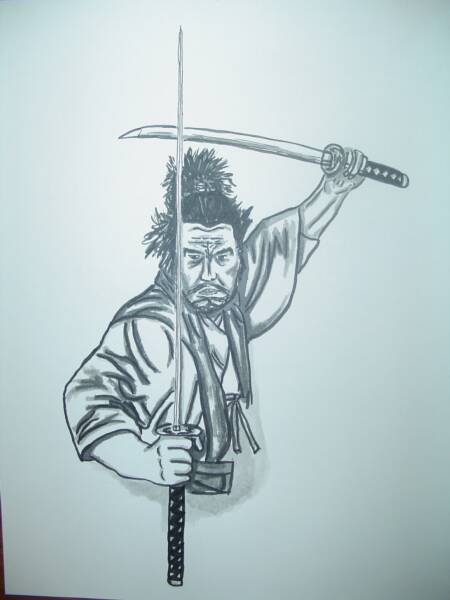
Miyamoto Musashi (宮本 武蔵?) (c. 1584–June 13 (Japanese calendar: May 19), 1645), also known as Shinmen Takezō, Miyamoto Bennosuke, or by his Buddhist name Niten Dōraku[1], was a Japanese swordsman famed for his duels and distinctive style. Musashi, as he was often simply known, became renowned through stories of his excellent swordsmanship in numerous duels, even from a very young age. He was the founder of the Hyōhō Niten Ichi-ryū or Niten-ryū style of swordsmanship and the author of The Book of Five Rings (五輪書, Go Rin No Sho?), a book on strategy, tactics, and philosophy that is still studied today.
Teachings
A picture of Musashi engaged in fantastic combat, by Utagawa Kuniyoshi (1798–1861).
Musashi created and perfected a two-sword kenjutsu technique called niten'ichi (二天一, "two heavens as one") or nitōichi (二刀一, "two swords as one") or "Ni-Ten Ichi Ryu" (A Kongen Buddhist Sutra refers to the two heavens as the two guardians of Buddha). In this technique, the swordsman uses both a large sword, and a "companion sword" at the same time, such as a katana and wakizashi.
It is said the two-handed movements of temple drummers inspired him, although it seems more likely that the technique was forged by a means of natural selection through Musashi's combat experience, or from jitte techniques which were taught to him by his father — the jitte was often used in battle paired with a sword; the jitte would parry and neutralize the weapon of the enemy whilst the sword struck or the practitioner grappled with the enemy. In his time a long sword in the left hand was referred to as gyaku nito. Today Musashi's style of swordsmanship is known as Hyōhō Niten Ichi-ryū.
Musashi was also an expert in throwing weapons. He frequently threw his short sword, and Kenji Tokitsu believes that shuriken methods for the wakizashi were the Niten Ichi Ryu's secret techniques. (see Hayakutake-Watkin: [1])
Musashi spent many years studying Buddhism and swordsmanship. He was an accomplished artist, sculptor, and calligrapher. Records also show that he had architectural skills. Also, he had a rather straightforward approach to combat, with no additional frills or aesthetic considerations. This was probably due to his real-life combat experience.
Especially in his later life Musashi also followed the more artistic side of bushido. He made various Zen brush paintings and calligraphy and sculpted wood and metal. Even in The Book of Five Rings he emphasizes that samurai should understand other professions as well. It should be understood that Musashi's writings were very ambiguous. Translating them into English makes them even more so. That is why we find so many copies of Gorin no Sho. One needs to read this work, Dokkodo and Hyoho Shiji ni Kajo to get a better idea of what he was about and understand his transformation from Setsuninto (the sword that takes life) to Katsujinken (the sword that gives life).
http://en.wikipedia.org/wiki/Miyamoto_Musashi
A picture of Musashi engaged in fantastic combat, by Utagawa Kuniyoshi (1798–1861).
Musashi created and perfected a two-sword kenjutsu technique called niten'ichi (二天一, "two heavens as one") or nitōichi (二刀一, "two swords as one") or "Ni-Ten Ichi Ryu" (A Kongen Buddhist Sutra refers to the two heavens as the two guardians of Buddha). In this technique, the swordsman uses both a large sword, and a "companion sword" at the same time, such as a katana and wakizashi.
It is said the two-handed movements of temple drummers inspired him, although it seems more likely that the technique was forged by a means of natural selection through Musashi's combat experience, or from jitte techniques which were taught to him by his father — the jitte was often used in battle paired with a sword; the jitte would parry and neutralize the weapon of the enemy whilst the sword struck or the practitioner grappled with the enemy. In his time a long sword in the left hand was referred to as gyaku nito. Today Musashi's style of swordsmanship is known as Hyōhō Niten Ichi-ryū.
Musashi was also an expert in throwing weapons. He frequently threw his short sword, and Kenji Tokitsu believes that shuriken methods for the wakizashi were the Niten Ichi Ryu's secret techniques. (see Hayakutake-Watkin: [1])
Musashi spent many years studying Buddhism and swordsmanship. He was an accomplished artist, sculptor, and calligrapher. Records also show that he had architectural skills. Also, he had a rather straightforward approach to combat, with no additional frills or aesthetic considerations. This was probably due to his real-life combat experience.
Especially in his later life Musashi also followed the more artistic side of bushido. He made various Zen brush paintings and calligraphy and sculpted wood and metal. Even in The Book of Five Rings he emphasizes that samurai should understand other professions as well. It should be understood that Musashi's writings were very ambiguous. Translating them into English makes them even more so. That is why we find so many copies of Gorin no Sho. One needs to read this work, Dokkodo and Hyoho Shiji ni Kajo to get a better idea of what he was about and understand his transformation from Setsuninto (the sword that takes life) to Katsujinken (the sword that gives life).
http://en.wikipedia.org/wiki/Miyamoto_Musashi

